
In the November 2014 issue of The Church Magazine, they posted a long article titled “What are our Young People Thinking: How to Witness to Youth of the Post 1980s, 1990s and 1995s,” written by Lu Zun’en. In it he describes the unique characteristics of each of these groups (generations) of young people, and suggests effective means of evangelistic engagement.
ChinaSource Team
•
March 3, 2015
•
Ideas

Earlier this month I got to spend two weeks back in Beijing, my former “home town.”
Joann Pittman
•
February 25, 2015
•
Stories

In addition to church leaders and ordinary Christians using online forums to discuss matters of faith, academics are joining the conversation as well. On his blog, Professor Liu Peng recently wrote about the relationship between poverty and “spiritual backwardness,” which refers to a spiritual void, or lack of spiritual beliefs. Writing from the perspective of sociology, Professor Peng argues that the most serious type of poverty in China is the “poverty of faith,” and unless that is addressed the problem of material poverty cannot be solved.
ChinaSource Team
•
January 6, 2015
•
Ideas

Earlier this month the Chinese web portal Sina posted a photo essay on the town of Yiwu (Zhejiang), where most of the world’s Christmas products come from.
ChinaSource Team
•
December 23, 2014
•
Stories

This afternoon the good folks at FEDEX delivered a small package to my house, and it wasn’t even a Christmas present. In fact, it was something better — my passport, with a brand-spanking-new Ten-year, multiple entry tourist visa to China.
Joann Pittman
•
December 22, 2014
•
Stories

Much is written these days about what makes China tick. It's the pragmatism. It's nationalism, and the desire to be a player on the world stage. It's "socialism with Chinese characteristics," which to some is just another way of saying capitalism.
Joann Pittman
•
December 19, 2014
•
Ideas
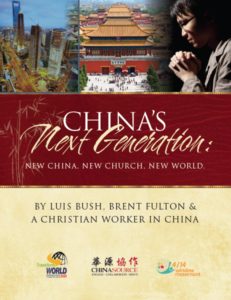
What a difference a decade makes! Over the last ten years the nation of China and the Chinese church have changed significantly; so has…
Brent Fulton, Luis Bush
•
December 14, 2014
•
Resources

All our favorite stories this week are about people or communities that are on the margins of Chinese society, either culturally or geographically: Orthodox Christians, Uighur factory workers, Hong Kong taxi drivers, and Miao villagers in Guizhou.
ChinaSource Team
•
November 7, 2014
•
Resources

Chinese young people are no different from their counterparts anywhere in the world in that a main question they face is the one of whom to marry. China’s rise and modernization has, in some ways, made this a more complicated question as ideas about marriage and qualifications for a spouse have evolved.
ChinaSource Team
•
November 4, 2014
•
Ideas

In the mid-1990s, while studying Chinese, I stumbled across a Chinese expression that was a "key" to helping me understand what was going on. I was working through a textbook called Speaking of Chinese Culture that taught about key Chinese cultural rules and values. One chapter was on this Chinese concept called nei wai you bie (内外有别), which means "insiders and outsiders are different."
Joann Pittman
•
October 28, 2014
•
Stories

What does it mean to be Chinese? Three articles this week highlight the complexity of being Chinese.
ChinaSource Team
•
October 10, 2014
•
Resources

On October 1, the Cornerstone Blog of The Religious Freedom Project at The Berkeley Center published two helpful posts on religious liberty in China.
Joann Pittman
•
October 9, 2014
•
Ideas