Last year members of the Almighty God sect savagely attacked a customer in a McDonald’s in northeast China after she refused to give them her cell phone number. Formerly known as Eastern Lightning, the Almighty God sect has emerged as one of the most active cults in China.
Brent Fulton
•
March 16, 2015
•
Ideas

The editor's point of view...
Brent Fulton
•
March 13, 2015
•
Scholarship

Grab your calculator – China’s leaders are at it again!
To usher in the Year of the Sheep, President Xi Jinping has placed his indelible stamp on Chinese history by unveiling the Four Comprehensives.
Brent Fulton
•
March 9, 2015
•
Ideas

Christians throughout history have seen themselves engaged in a battle that is ultimately spiritual in nature. Forces arrayed against them, political or otherwise, are physical manifestations of this unseen battle, which will ultimately conclude with the return of Christ.
Brent Fulton
•
March 2, 2015
•
Ideas

For first-generation urban Christians in China, social expectations regarding marriage present difficult dilemmas as they seek to remain faithful to biblical teaching regarding the family.
Brent Fulton
•
February 27, 2015
•
Ideas

With a plethora of Christian leader development programs on offer in China, it is difficult to know which are appropriate, not to mention which will ultimately prove effective.
Brent Fulton
•
February 9, 2015
•
Ideas

The forced removal of crosses from literally hundreds of churches in the Wenzhou area during the past year has called attention not only to the local government’s heavy-handed approach toward the church, but also to the phenomenon of the church buildings themselves.
Brent Fulton
•
February 2, 2015
•
Stories

The development of leadership training within China’s unregistered church has followed a trajectory that roughly parallels that of the larger society as it has experienced major advances in education, a rising standard of living, and massive urbanization.
Brent Fulton
•
January 30, 2015
•
Ideas

An introduction to the 2014 winter issue by the editor of the ChinaSource Quarterly.
Brent Fulton
•
January 14, 2015
•
Scholarship
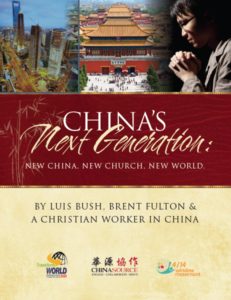
What a difference a decade makes! Over the last ten years the nation of China and the Chinese church have changed significantly; so has…
Brent Fulton, Luis Bush
•
December 14, 2014
•
Resources

Given the relatively opaque nature of China's church, international organizations have often found it difficult to know where to connect. Chinese representation at several high-profile international conferences in recent years has, in some ways, been a welcome breakthrough. These events have ostensibly helped to bring together a wide spectrum of leaders from within China with those from abroad who are seeking to partner with them.
Brent Fulton
•
November 12, 2014
•
Ideas

In Mobilized Merchants - Patriotic Martyrs, Dr. Timothy Conkling sheds much-needed light on the relationship between China's unregistered church and the Chinese Party-State. The dissertation research that forms the basis for the book set out to answer the question of why Chinese Christians are persecuted and how they respond to this persecution.
Brent Fulton
•
November 10, 2014
•
Ideas