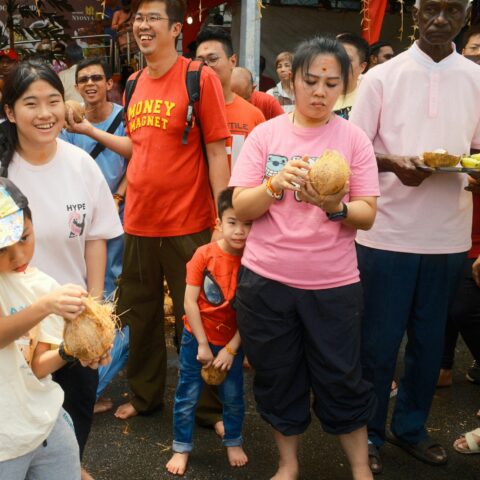
Public Mission in a Pluralistic Social Context
Can the Malaysian Chinese Church shift from a community primarily concerned with its own survival to one that participates in the holistic mission of God and seeks the peace of this land?
Engage theological scholarship and reflection arising from Chinese Christian contexts, exploring Scripture, doctrine, church traditions, and questions facing the wider church.
Can the Malaysian Chinese Church shift from a community primarily concerned with its own survival to one that participates in the holistic mission of God and seeks the peace of this land?

Resources for Chinese Public Theology

The thoughtful and wide-ranging contributions in this issue of ChinaSource Journal are particularly relevant to where China’s church finds itself today.

By looking not only at the church in China itself but also to Christian communities in the global Chinese diaspora, these scholars offer both cautionary tales as well as hopeful visions of what it means to be a witness to the “public God.”

The Chinese diaspora in Europe is transitioning from being a “mission field” (the recipient of gospel activity) to a burgeoning “mission force” (the agent of missional change).

Long before the word “Trinity” was rendered into Chinese as sanwei yiti (三位一體), Christians in Tang China were already searching for language to express the mystery of Father, Son, and Holy Spirit.

We must move toward a global dialogue where the Western scholar, the African pastor, the Asian theologian, and the Latin American activist sit together as equals.

If we are to truly appreciate theology from a worldwide perspective, surely we need to engage theology in other languages.

When people who have long been studying, teaching, pastoring, and serving in different contexts finally sit in the same room, what becomes visible?

The conference, "Chinese Christian Scholarship and the Church in Global Perspective: Review and Prospect," organized by the Institute of Advanced Studies of Chinese Christianity (IASCC) was certainly a fruitful event.

The universalizing claims of the Gospel about an unchanging God are spoken of in tension with the subjectivizing conditions of our lives in an ever-changing world.

The Chinese church is gradually moving from numerical breadth to intellectual maturity—from movement-driven growth to the building of institutions and a knowledge tradition.