Editor’s Note: This is the final installment in a three-part series adapted from Hugh Battye’s A Tale of Two Chinas, drawing on his fifteen years of life and ethnographic research in mainland China. After reflecting on the diversity often hidden within the singular idea of “China” in Part One and recounting his fieldwork among the Bonan in Gansu in Part Two, Battye travels here into the Tibetan grasslands of Gannan. Through family life, food, language, religion, and an unexpected memory of an earlier Christian presence, this final excerpt offers another glimpse into the cultural worlds that complicate any simple picture of China.
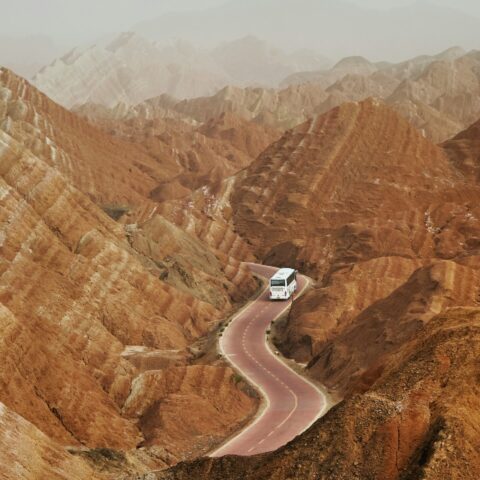
In the summer of 2016, my Korean friend and doctoral classmate, Changmin, invited me on a trip to the only Tibetan prefecture in Gansu Province, Gannan, which was the focal area of his academic research. Setting out from the neat but underwhelming prefectural capital, a couple of hours’ bus ride took us up into the grasslands and to the remote county of Machu, so named after the Tibetan for “Yellow River”, on whose first major bend it sits. Arriving at the county seat, we were met by Changmin’s student contact Lobsang, who treated us to a sumptuous hotpot, before driving us up to the local monastery, where the more spiritually minded townspeople were fixated on a ritual performance by the mask-cladded monks, while others seemed just as content to take advantage of the day off and enjoy a picnic on the grassy surroundings. We eventually set off for his family home, driving for four hours on bumpy tracks, past grazing yaks and horses, and dovetailing the winding river, where the clear water produced a stunning mirror-like reflection of the low-hanging clouds overhead.
天下黄河贵德清
Tianxia Huanghe Gui-de Qing
Under heaven the Yellow River is clearest in Gui-de.
This famous saying, referring to a county further downstream and coined by a visiting official, which in China is the ultimate authentication of a truth universally acknowledged, could just as easily apply to Machu or any of the other upper reaches. Up here on the edge of the Tibetan plateau the pristine, free-flowing waters could not be in sharper contrast to the silt-ridden inundation that is the hallmark of the river’s lower levels, as it continues snaking its three thousand mile course all the way to the Bohai Sea.
We finally parted company with the river and headed up into pure grassland, passing a solitary boy who could not have been much older than eight, standing on duty before a whole herd of yak on the hillside beyond. Eventually the track took us up a slope to Lobsang’s family accommodation, which consisted of a single earthen hut together with a nomadic “black tent” made from yak hide. A smaller, conventional tent had been pitched not far away, which turned out to be for Changmin and myself, while in front of us the ground sloped gently down to where the family’s one hundred and forty or so yak and sheep, together with a couple of brown taurine bulls and a handful of Tibetan ponies, grazed in the valley below. After settling down to an evening meal of rice and mutton, cooked by Lobsang’s sister-in-law in the black tent’s metal stove, we retired to our own tent for a fitful sleep, as even the two blankets provided, together with my warm clothes, weren’t quite enough to counter the dramatic cooling effect of 3,500 meters of altitude on Gansu’s sweltering summers.
The following morning, while we were relaxing back in the black tent, suddenly the cry rang out that three stray mastiffs had entered the pasturelands and were ravaging the sheep, a call that sent some of the younger family members immediately hurtling down the slope to shoo them away. Too late, however, and the resultant death of one of the flock resolved the question of the main menu for the rest of our time there. While Lobsang, his cousin and uncle set to work immediately on the dead animal, Lobsang’s brother Zhaxi, a stylish nomad with shoulder length hair, concentrated on his own project of fixing the generator which supported their well’s water pump, after which he was able to fill the troughs for the cows. The men took it in turns to watch the herd and flock throughout the day, making efficient use of ponies or motorbikes to traverse the valley, and in the evening Zhaxi’s wife, as expert in husbandry as she was a culinarian, hooked up the female yaks designated for milking the next morning, whilst adroitly managing to separate their young from them for the night, against all manner of bovine protestation.
By dinner time, the mutton, together with the innards, which were made into sausages using the small intestine, was ready. Fortunately, at that stage I had not thought through the potential implications of consuming an animal killed by marauding dogs, and neither, I presume, had Changmin, which served to prevent what would have been a very awkward situation, had we been more health conscious. In the event, we tucked in without any scruples, and in true nomad style: no plates or frills, just a chunk of meat in one hand and a short handled knife in the other. Aside from mutton and yak meat, the major staple of the region is tsampa, made from roasted highland barley, which the individual mixes with tea and yak butter by hand as they consume it, a process we engaged in during the course of the second morning. On this point, Lobsang’s father, gentle but authoritative, his face weather-beaten from years labouring on the plateau, came into his own, as he extolled the health benefits of tsampa, claiming that it was the Dalai Lama’s choice for breakfast every morning. All this was, however, relayed to us through Lobsang’s translation, since his father, as well as Zhaxi his brother, could not speak any Chinese, an increasingly rare phenomenon in the modern People’s Republic. For now, however, we were content to observe that there was, indeed, some corner of a foreign field, which was still—to all intents and purposes—Tibetan.
After a couple of days of idyllic summer life on the grasslands, we prepared to return to the county seat to attend the much fêted annual horse racing festival. Although he had driven us out quite competently, it turned out that Lobsang did not actually have a driving licence, and he was concerned that the traffic police would now be out in force to check on drivers arriving for the festival. I offered to drive, but I had not brought my Chinese license with me, which would also make it an offense under local law. In turn, Changmin had his license on him, but lacked confidence, since he had not driven for so long on conventional roads, let alone dirt tracks. After we had deliberated for a while on whether we preferred the risk of arrest or accident, Lobsang agreed to drive, and we set off late in the day, in order to reach the town after dark. This, in combination with the standard mainland technique of checking on the traffic police situation ahead from people driving past the other way, ensured that we arrived at our destination without incident. Discovering that most of the hotels were already fully booked, we eventually found a cheap but roomy hostel, where, after a dinner out with Lobsang and Zhaxi, who had also accompanied us into town, Changmin and I settled in for the night.
In the morning, my somewhat naïve vision of Tibetan nomads racing free across the grasslands was put right immediately, as we arrived at the venue to find a formal racecourse with starting boxes for the horses, an opening ceremony, and all the usual government speeches about Socialism with Chinese Characteristics and ethnic harmony. These did nothing, however, to dull the enthusiasm of the crowds, who lined the grassy banks either side of the grandstand to cheer the riders on: old ladies with braided grey hair spinning their prayer wheels, mothers sporting long sleeved T-shirts and beaded necklaces clutching their children, young men in trendy Western clothes. And despite the formalities, the Tibetan characteristics came out too, with some of the jockeys riding saddleless, and those on duty for the presentations attired in elegant and complementary male and female chuba outfits. Finally, although there were some competitors from the east coast, those from the plateau gained the top spots—in the 2000 meter final, by which time Changmin and I had migrated from the bank to the grandstand for the price of fifty yuan each, horse-rider teams from Xunhua County in Qinghai came in first and third, the winners just pipping a pair from Lhasa.
My Tibetan excursion concluded, a few days later, in the picturesque town of Langmusi, which straddles the border of Gansu and Sichuan provinces at an altitude of 3,300 metres, each side boasting its own monastery of golden roofed temples set against dramatic mountainous backdrops. I had been volunteered by a professor in my department to take part in the first episode of a documentary series following the Bailong River, which rises just to the west of the town. In the program I was to play a tourist trying to find traces of the legacy of Robert Ekvall, an American missionary from the 1930s and 40s, who had had a significant impact on the region, establishing a local school. As part of the filming process, I was privileged to interview an elderly Tibetan woman who still remembered him from when she was a young child. But I was slightly taken aback by the candidness of her recollection, even after so many years, which seemed to crowd out any sense of nostalgia for days gone by. The man, she said abruptly, they respected, but not his Christianity, and she went on to emphasize how some children were banned from attending his school due to the religious element. In any case, I since lost touch with the directors, and I do not know if her words or my role ever made the screen. Certainly, apart from a brief interview in which I was dressed as a Tibetan following a performance in Lanzhou a few years previously, that was about the sum of my Chinese television career. But in another way that trip turned out to be just a beginning. For up until that time, I had largely focussed my research on the Bonan and other local Muslim peoples. When, however, the following year, an opportunity presented itself to contribute a chapter in a European publication on the Tibetan regions of Qinghai and Gansu, I decided to expand my scope to include the Buddhist community in Rebgong that the Bonan had left behind when they had emigrated a century and a half previously. I took the leap from the Muslim world into the Tibetan.